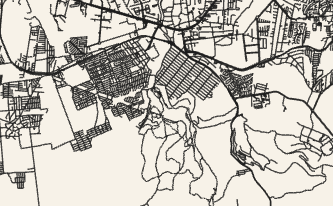
One of the interesting parts of cross-cultural ministry is learning local history that cannot be learned through courses or books, but rather through face-to-face conversations. Recently I was talking to Fernanda, a local shopkeeper, and we got around to talking about the early days when the neighbourhood of Santa Bárbara was first being established – about 40 to 50 years ago. At that time there was no Roman Catholic church in the neighbourhood and so people had to travel elsewhere to attend mass.
That changed when Roman Catholic missionaries from a nearby convent (just around the corner from Pan de Vida) started making weekly trips to teach catechism and celebrate the Mass. This ministry was carried out mainly in people´s homes – such as Fernada´s home. Her father would invite the Catholic missionaries into their house and Mass would be celebrated in the home, in place of a church or chapel.
One interesting note about these Roman Catholic missionaries – they would often spend several nights or weeks living with a family that had requested spiritual care. This might be because of a failing marriage or troubles with their children. In order to really understand the issue, the missionaries would actually live for a time with the family and observe the dynamics of the family and the interpersonal relationships at play – certainly an interesting approach to ministry!
Fernanda also told me about how youth groups were established throughout the neighbourhood in different homes. These youth groups played a vital role in the spiritual formation of her generation and, I think, for the neighbourhood as a whole.
As I reflected on the history that Fernanda had told me about, two thoughts struck me.
First, those first Catholic missionaries came with the same broad goal as we did when we first started ministry in the same neighbourhood. In fact, Fernanda had commented to me that the missionaries came to Santa Bárbara because it was known as a place of need – alcoholism, broken families, worldliness. Those were many of the reasons we came as well.
And yet, the gospel that we brought was quite different. The Roman Catholic “gospel” is a distortion of the biblical gospel – it offers people a Christ that is able to save, yes, but only with human cooperation and effort, including that of the “saints”. The gospel we bring is that Christ is completely sufficient to save – even a weak and fragile faith in a strong Christ is enough to be saved. This is the gospel that can truly bring about the deep transformation that those original missionaries were looking for.
The second thought I had while reflecting on my conversation with Fernanda was related to what Jesus says in Matthew 10:37-38:
The one who loves a father or mother more than me is not worthy of me; the one who loves a son or daughter more than me is not worthy of me. And whoever doesn’t take up his cross and follow me is not worthy of me.
Fernanda, and many others of her generation, is someone steeped in the traditions and teachings of the Roman Catholic church. She grew up watching Mass being celebrated in her home! Even today, she remains very involved in the church and often helps read select passages of the Scriptures during Mass. Her family and community is built around the Roman Catholic church. She is devoted to the Virgin of Guadalupe. She claims to have seen blood drip from the host (the wafer/bread) during a Mass.
So, for Fernanda to truly follow Christ and embrace the gospel of grace, she will, in effect, have to “hate” her father and mother, sister and brother, friends and neighbours. Following Jesus would cost her dearly.
Of course, the cost would be worth it.
Let´s pray that the powerful Holy Spirit would open her eyes to the gospel of grace and to the infinite worth of following Jesus no matter the cost.


Leave a comment